How we built the Richmond Hill Votes website with AI tools
Richmond Hill Votes is an independent guide to the 43 candidates in Richmond Hill's 2026 election. It puts every candidate's promises and every incumbent's voting record in one place. We built it in two days with AI tools.
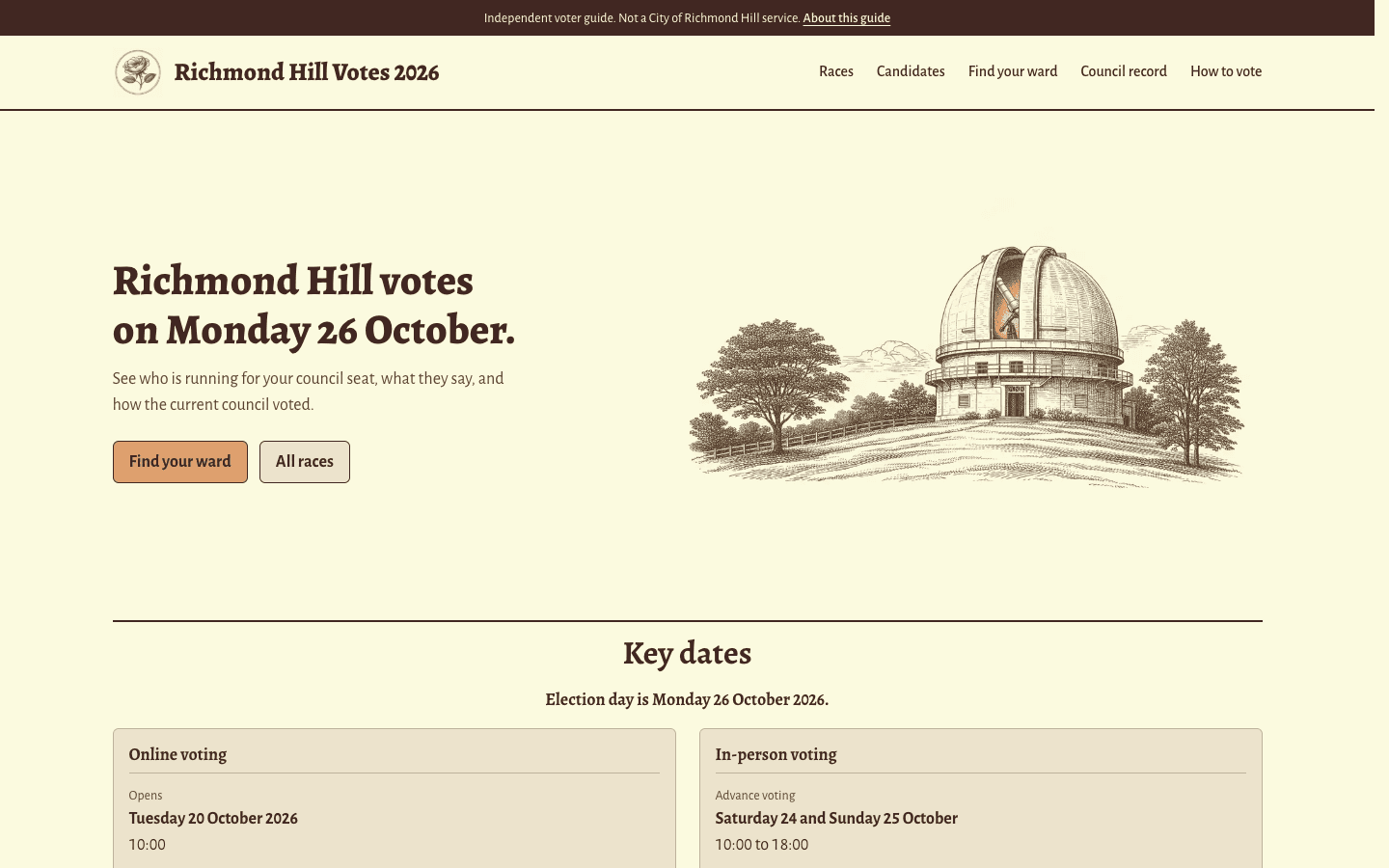
Richmond Hill Votes is an independent voter guide for the October 26, 2026 municipal election Source 1. It covers all 43 candidates in 13 races, quotes 408 of their statements in their own words, and links each of its 256 sources from the page it supports. About one in six people who voted in Richmond Hill used it, by our count of the browsers that opened it Source 8. We built it with AI tools in less than two days from the first request, and we planned, designed, checked and tuned it for search as we would a client's website.
Reach, against the City's unofficial results
- 1 in 6
- Guide users to ballots cast
Search Console, October 5 to 27
- 7,591
- Clicks from Google
- 79,687
- Times shown in Google
- 9.5%
- Searchers who clicked
- 5.3
- Average spot in results
Daily clicks from Google search
- 4
- 32
- 40
- 22
- 56
- 57
- 80
- 96
- 91
- 92
- 127
- 151
- 240
- 568
- 422
- 377
- 364
- 561
- 1017
- 2897
- 297
October 2026
Vercel, launch through election day
- 1.05M
- Requests served by Vercel
- 62,776
- Page loads by people
- 9,519
- Browsers that opened the guide
We set the rules before writing any code
On the morning of Monday, October 5, we scoped the guide in Instinct, an AI research assistant. It produced a candidate roster from the City's certified list Source 2 and a brief for Claude Code. The guide sticks to facts, covers every candidate equally and gives no scores or endorsements, because Ontario's third-party advertising rules apply to anything that promotes, supports or opposes a candidate Source 4. Where a candidate has published no position, the page says so and gives the date we last looked Source 6.
Our web design process started with a wireframe
With Claude Code we wrote the wireframe, a plain plan of every page that lists its blocks and what each part shows when information is missing. We picked five colours in Coolors and kept scarlet to small marks, because red reads as a party colour in Canada. A free font-pairing tool suggested Alegreya and Alegreya Sans, and Claude Design turned the wireframe, colours and fonts into 14 design boards. Before the build started, three Claude review agents read the boards for accessibility, neutral wording and visual craft, and we fixed the seven blocking problems they found.
We redrew the art AI got wrong
GPT Image drew the guide's engraving-style icons and its drawings of Richmond Hill places. One prompt began:
One icon only: a crosshair target with four short ticks, meaning 'use my location'. Flat monochrome line icon in a fine ink-engraving style...
The observatory came out wrong five times, so we redrew it from a photograph of the real dome. The ward icon showed about nine wards, and we drew our own by hand with the six in the boundary data. The logo is a garden rose because Richmond Hill was once the Rose Capital of Canada Source 3.
- Ballot box
- Calendar
- Compare
- Correction
- External link
- Map pin
- Source
- Ward map
- Voted yes
- Voted no
- Abstained
- Absent
- Not recorded
We sent the build back and launched in two days
We sent Claude Code's first pass back with three changes: the ballot first on every race page, a street map for finding your ward, and candidates' statements quoted word for word. A draft site was public that Monday night, and Claude in Chrome opened each page as a visitor would and logged anything that failed. We worked through those fixes on Tuesday and put the guide live on its own domain late that night.
We checked every vote and asked before using photos
Positions come only from what a candidate wrote on their campaign site or emailed from the address on the certified list Source 7. Claude Code drafted each council vote record from the saved City and York Region minutes, and we checked every one against them Source 5. An AI tool called TypeSafe suggested topic labels for the votes and positions, and we approved each label.
On October 7 we asked the City Clerk and each candidate with a public email for permission to use their photo until election day. Anyone who said no or didn't reply appears on a card with their initials. The portraits came down after election day, as each permission said.
Search work put the guide near the top of Google
On launch night we ran several hundred searches through Google's autocomplete, the suggestions shown as you type, and rewrote each page's title and description in the phrases people use. We submitted a sitemap, the file that lists every page, to Google Search Console, Google's tool for site owners, and asked Google to index each new page as it went up. A small change on October 9 made Google drop the home page, so we traced the cause and fixed it on October 12, and Google had the page back the next morning.
From October 5 to 27 the guide drew 7,591 clicks from Google search, 2,897 of them on election day. For the top search, "richmond hill election candidates", it sat near the top of the first page, and more than a quarter of the people who saw it there clicked through. Google's AI answers, AI Overviews and AI Mode, showed the guide about 2,300 times, mostly in the week online voting was open.
Our AI consulting brings the same judgment to your business
On this project the AI tools drafted, and we decided what to reject or check by hand. With a business, we agree what each tool is for and write the rules down, and your people approve what the AI drafts against them. If you need a website that gets found, start with how we help you get more customers. If you want AI working inside your company, see our custom systems work or browse more of our work.
Based in Richmond Hill or elsewhere in York Region? We build websites for Richmond Hill businesses and run AI training for Richmond Hill teams.
FAQs
What readers usually ask
Who publishes it and who pays?
SimpleVision.AI publishes the guide as its own civic project and pays for it: the domain name and the hosting on Vercel. It runs no analytics or tracking scripts, so nothing records what a voter reads.
How many people used the guide?
We estimate about 7,000 to 9,000 people used the guide, over 10,000 to 14,000 visits. Against the City's unofficial results, that is about one in six people who voted and one in twenty who could. Our count also includes candidates, campaign teams and readers from outside the city. Most of the traffic came in the final week, after online voting opened on October 20, and election day alone brought more than a third of it.
Which tools did you use?
- Plan: Instinct, an AI research assistant, for the scope, requirements and brief.
- Design: Coolors for the five colours; a font-pairing tool for Alegreya and Alegreya Sans; Claude Design for 14 boards; GPT Image for 15 icons and 8 drawings.
- Build: Claude Code for the wireframe, the build and every change since; Resend for the correction-form email; TypeSafe for draft topic labels.
- Review: Claude review councils, one report per lens; Claude in Chrome testing every page of the draft site; a second Claude model checking each change before release.
- Launch: Google Search Console for the sitemap, indexing and search results.
Is it neutral?
Yes. One set of rules covers every candidate, from the fields on their page to the sources we check and the correction form. The rules are on the methodology page.
What does AI consulting with a human in the loop look like?
AI drafted the research, designs, icons, code and first reviews to rules we set, and we rejected what was wrong, checked each vote against the minutes and approved everything before it went live. With a business, we build that review into your team's own work.
By SimpleVision, a Toronto practice built on 10+ years of product marketing and strategy for brands like Google, Apple, and Walmart. About the practice → We write with AI and check every figure against its source. How we write →
Sources 8
- 1City of Richmond Hill, Voter information (online voting October 20 to 26; Voting Day October 26, 2026)
- 2City of Richmond Hill, Election candidates (certified list)
- 3Richmond Hill Historical Society, Richmond Hill: Rose Capital of Canada
- 4Government of Ontario, 2026 third-party advertisers' guide: third-party advertising
- 5Richmond Hill Votes, Council record
- 6Richmond Hill Votes, Methodology
- 7Richmond Hill Votes, Corrections
- 8City of Richmond Hill, Richmond Hill unofficial 2026 municipal elections results (44,604 ballots cast, 159,441 eligible electors, turnout 28%)
Where this leads
Build the systems that run your business.
Custom AI that takes the busywork off your plate and runs in the background, so you get time back and revenue moving.